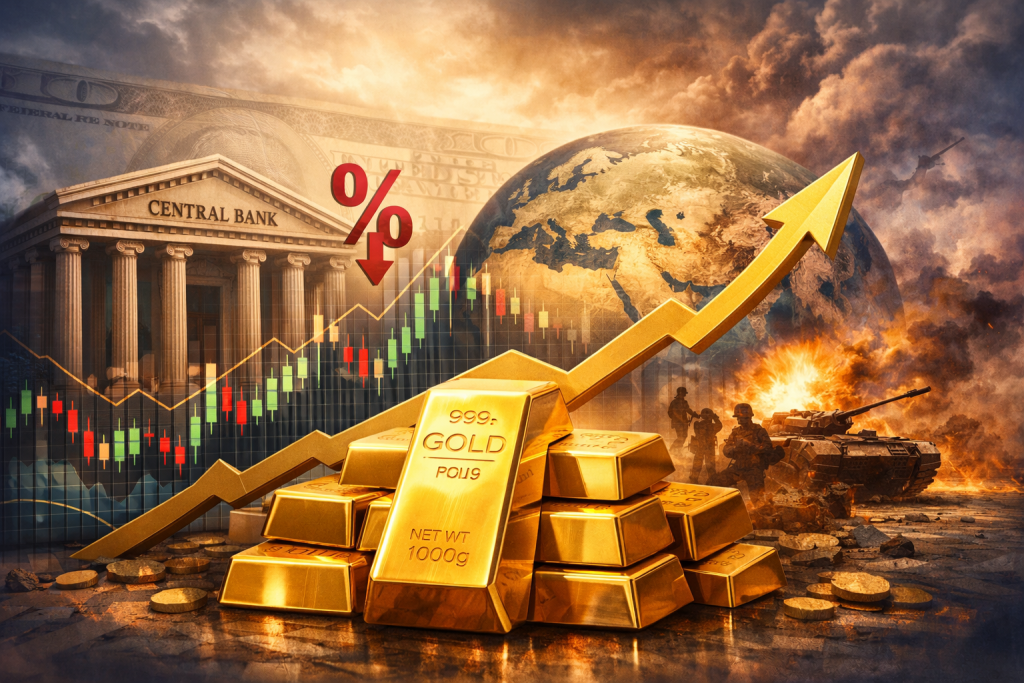
Gold Outlook for 2026 Monetary Easing Expectations and Rising Uncertainty
Gold has entered 2026 with a level of strength that reflects more than short-term speculation. The metal’s sustained performance is closely tied to a changing macroeconomic environment, where expectations around monetary easing, persistent geopolitical risks, and structural uncertainties are reshaping investor behavior. Rather than reacting to isolated events, gold is responding to a broader transition in how markets price risk, liquidity, and long-term stability.
As central banks signal a gradual move away from restrictive monetary policies and global tensions remain unresolved, gold continues to attract attention as a strategic asset. This outlook is not built on aggressive price targets, but on understanding the forces that are likely to define market conditions throughout 2026.
This article explores the key drivers shaping the gold outlook for 2026, focusing on monetary policy expectations, geopolitical uncertainty, inflation dynamics, and evolving investor positioning.
The Macro Backdrop Entering 2026
The global economy enters 2026 in a state of cautious adjustment. Growth remains uneven across regions, inflation has moderated from peak levels but remains structurally elevated, and financial conditions are slowly transitioning after an extended period of tight policy.
Unlike previous cycles, this transition is happening against a backdrop of heightened political and geopolitical complexity. Markets are not simply adjusting to economic data; they are navigating overlapping risks that influence confidence, capital flows, and long-term expectations.
Gold’s role in this environment is shaped by its ability to perform when traditional signals become less reliable.
Monetary Easing Expectations and Their Impact on Gold
One of the most important themes for gold in 2026 is the growing expectation that central banks will adopt more accommodative monetary policies.
After years of aggressive tightening to combat inflation, policymakers are increasingly focused on balancing inflation control with economic stability. Slower growth, financial market sensitivity, and rising debt servicing costs have made prolonged restrictive policy difficult to sustain.
For gold, this shift matters for several reasons.
Lower interest rates reduce the opportunity cost of holding non-yielding assets. When real yields decline or move closer to zero, gold becomes more competitive relative to fixed-income instruments. Even the expectation of easing, rather than the actual implementation, can influence investor behavior and asset allocation.
Markets tend to price these shifts well in advance, and gold often reacts early to changes in monetary policy expectations.
Real Yields and Gold’s Relative Appeal
Gold’s relationship with real yields remains central to its performance outlook. Real yields, which account for inflation-adjusted returns on bonds, represent the true cost of holding gold.
When real yields are high, gold faces headwinds. When they decline or become volatile, gold’s appeal increases. In 2026, real yields are expected to remain under pressure as central banks navigate slower growth and persistent inflation risks.
Even if nominal rates remain elevated in some regions, inflation uncertainty can erode real returns. This environment supports gold as a form of long-term value preservation rather than a tactical trade.
Central Bank Behavior Beyond Interest Rates
Central banks influence gold not only through interest rate policy but also through reserve management decisions.
In recent years, central bank gold purchases have increased as part of broader diversification strategies. This trend reflects a desire to reduce reliance on traditional reserve currencies and strengthen balance sheet resilience in a more fragmented global system.
Looking into 2026, this behavior is expected to continue. Central bank demand provides structural support for gold prices and reduces downside sensitivity to short-term market fluctuations.
This demand is not driven by speculation but by long-term strategic considerations, which makes it particularly significant for gold’s outlook.
Persistent Geopolitical Uncertainty
Geopolitical risk remains one of the most difficult variables for markets to price. Unlike economic indicators, geopolitical developments are unpredictable and often escalate quickly.
Tensions involving major global players continue to affect energy markets, trade relationships, and diplomatic stability. Unresolved conflicts, sanctions, and political pressure create ongoing uncertainty that weighs on global confidence.
In 2026, these risks are not expected to disappear. Instead, they form a persistent layer of uncertainty that influences investor behavior and reinforces demand for safe-haven assets like gold.
Gold benefits from this environment not because it reacts to every headline, but because it provides insurance against scenarios that are difficult to quantify.
Energy Markets and Inflation Sensitivity
Energy markets remain closely linked to geopolitical developments. Disruptions or threats to supply can quickly affect prices, feeding into broader inflation expectations.
While inflation has moderated compared to previous peaks, structural pressures remain. Energy transition costs, supply chain realignment, and regional conflicts contribute to inflation uncertainty even in periods of slower growth.
Gold performs well in environments where inflation outcomes are unclear. It does not require inflation to rise sharply; it benefits when confidence in stable pricing erodes.
As long as energy markets remain sensitive to geopolitical risk, gold is likely to retain its role as an inflation hedge.
Investor Risk Perception Is Shifting
One of the defining features of the current cycle is a shift in how investors perceive risk.
Traditional diversification models have faced challenges as correlations between asset classes have increased. Equities and bonds have, at times, moved in tandem, reducing the effectiveness of conventional portfolio construction strategies.
This has led investors to reconsider assets that offer genuine diversification benefits. Gold’s low correlation to financial assets, particularly during periods of stress, makes it attractive in this context.
Rather than viewing gold as a short-term hedge, many investors are incorporating it as a strategic allocation aimed at long-term risk management.
Gold’s Role in Portfolio Construction in 2026
In 2026, gold’s role in portfolios is increasingly defined by stability rather than speculation.
Institutional investors, asset managers, and long-term allocators are reassessing portfolio resilience in a world where macro risks are more persistent. Gold’s liquidity, transparency, and historical performance during crises support its inclusion as a core asset.
This structural demand differs from momentum-driven buying. It tends to be more stable and less sensitive to short-term price movements, contributing to gold’s ability to maintain elevated levels.
Political Risk and Policy Uncertainty
Political risk remains a key variable influencing gold’s outlook. Election cycles, policy shifts, and changing geopolitical alliances add layers of uncertainty to the global landscape.
Policy uncertainty affects markets not only through direct decisions but also through expectations. Changes in trade policy, sanctions, or diplomatic relationships can alter growth and inflation outlooks rapidly.
Gold benefits from this uncertainty because it is not tied to the performance or credibility of any single political system. Its neutrality becomes more valuable when confidence in policy stability weakens.
The Dollar, Currency Dynamics, and Gold
Currency movements, particularly involving the US dollar, play an important role in gold pricing.
While gold is often inversely correlated with the dollar, the relationship is not always straightforward. In periods of global stress, both gold and the dollar can attract demand simultaneously.
Looking into 2026, currency volatility is expected to remain elevated as central banks diverge in policy paths and geopolitical tensions influence capital flows. This environment supports gold’s role as a global store of value rather than a currency-specific trade.
Is Gold’s Strength Sustainable in 2026?
A key question for investors is whether gold’s current strength can be sustained throughout 2026.
While short-term corrections are always possible, the fundamental drivers supporting gold remain largely intact. Monetary easing expectations, persistent geopolitical risk, and structural inflation pressures continue to shape market behavior.
Rather than viewing gold’s performance through the lens of precise price targets, it may be more useful to consider its role within a broader macro framework. Gold reflects the cost of uncertainty, and that cost remains elevated.
Understanding Gold Beyond Price Forecasts
Gold’s outlook should not be reduced to numerical forecasts alone. Its value lies in its function within the financial system.
Gold performs best when markets struggle to assess future risks accurately. In such environments, assets that preserve value across scenarios become increasingly important.
The outlook for 2026 suggests that uncertainty will remain a defining feature of global markets. This supports gold’s relevance regardless of short-term fluctuations.
Gold as a Reflection of a Changing Global System
Gold’s performance also reflects deeper changes in the global economic and financial system.
Rising debt levels, geopolitical fragmentation, and evolving monetary frameworks challenge assumptions that defined previous decades. In this context, gold represents continuity and resilience.
As these structural shifts continue to unfold, gold’s role as a stabilizing asset is likely to remain relevant.
Conclusion
The gold outlook for 2026 is shaped by a convergence of monetary easing expectations and rising global uncertainty. Central bank policy shifts, geopolitical risks, inflation sensitivity, and changing investor behavior all contribute to an environment where gold retains strategic importance.
Gold’s strength is not driven by a single narrative, but by a complex interaction of macro forces that continue to evolve. As long as uncertainty remains elevated and confidence in traditional risk frameworks is challenged, gold is likely to remain a key component of global portfolios.
Understanding gold’s outlook requires looking beyond short-term price movements and focusing on the broader forces shaping markets in 2026 and beyond.