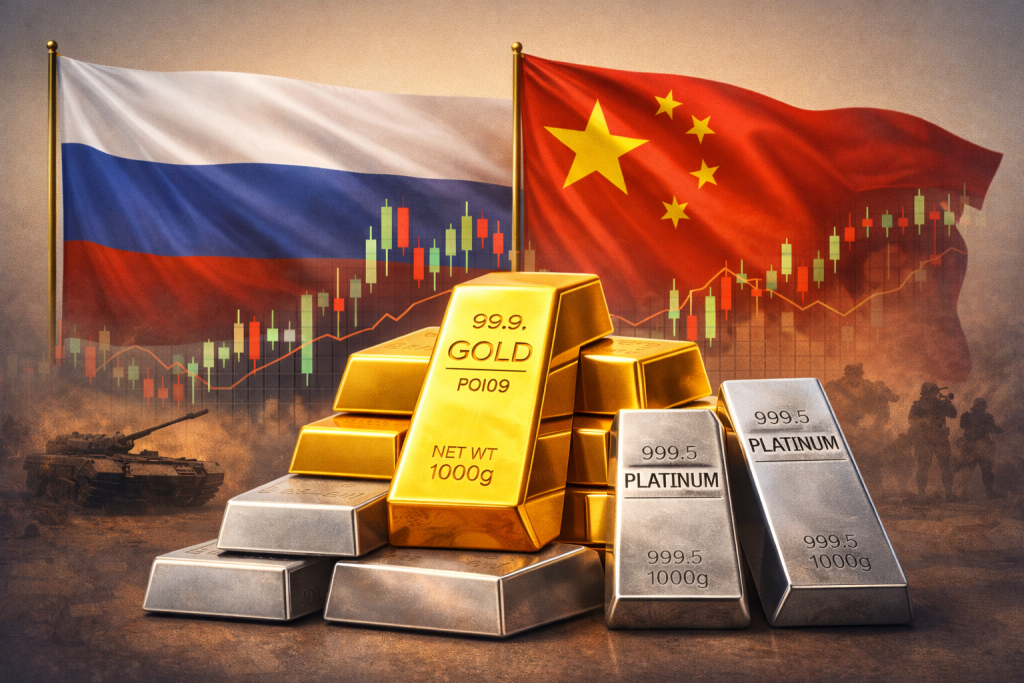
How Geopolitical Tensions Are Reshaping Demand for Precious Metals
Geopolitical risk has always been a key driver of financial markets, but in recent years it has become a constant rather than an exception. Conflicts, sanctions, trade disputes, and political instability now shape investor behavior on a structural level. As global tensions remain elevated, demand for precious metals is being reshaped in ways that go beyond short-term price reactions.
Gold, silver, platinum, and palladium are increasingly viewed not only as commodities, but as strategic assets that respond to uncertainty in unique ways. In 2026, this shift is becoming more visible as geopolitical developments continue to influence energy markets, supply chains, monetary policy expectations, and capital flows.
This article explores how geopolitical tensions are transforming demand for precious metals, why different metals respond differently to risk, and what this changing landscape means for investors and markets.
Geopolitics as a Structural Market Force
In earlier market cycles, geopolitical events were often treated as temporary disruptions. Markets reacted, volatility spiked, and then attention returned to economic fundamentals. Today, geopolitical risk has become embedded in the global system.
Conflicts and political tensions are no longer isolated. They interact with trade policy, energy security, technological competition, and monetary strategy. As a result, investors are adjusting not just tactically, but structurally.
Precious metals benefit from this shift because they are perceived as assets that sit outside political systems. They are not liabilities of governments, they do not depend on policy credibility, and they are globally recognized stores of value.
The Safe-Haven Function of Precious Metals
Precious metals have historically played a safe-haven role during periods of crisis. However, the nature of that role is evolving.
Gold remains the primary beneficiary of geopolitical stress due to its liquidity, depth, and global acceptance. Silver, while more volatile, often follows gold during periods of heightened risk, especially when investment demand rises alongside industrial demand uncertainty.
Platinum and palladium respond differently. Their demand is more closely tied to industrial use, particularly in the automotive and manufacturing sectors. However, geopolitical disruptions to supply chains can significantly affect these metals, reshaping demand dynamics in unexpected ways.
Energy Security and Its Impact on Precious Metals
Energy markets are one of the most direct channels through which geopolitical tensions influence precious metals demand.
Conflicts and sanctions involving major energy producers affect oil and gas supply expectations. Even the perception of risk can push prices higher, increasing inflation sensitivity across economies.
Gold benefits from this environment as a hedge against inflation uncertainty. When energy costs rise or become volatile, confidence in stable pricing weakens, and investors turn to assets that preserve purchasing power.
Silver also gains relevance in this context due to its dual role as a precious and industrial metal. Energy transitions and renewable technologies rely heavily on silver, linking geopolitical energy risks directly to silver demand.
Supply Chain Disruptions and Metal Availability
Geopolitical tensions often disrupt supply chains, affecting the availability of raw materials and refined metals.
Sanctions, trade restrictions, and logistical bottlenecks can limit supply or increase costs. For precious metals, this can create additional pressure on prices and influence investment behavior.
Platinum and palladium are particularly sensitive to supply disruptions due to their concentrated production. Political instability or sanctions in producing regions can quickly alter market balances.
As supply risks increase, investors pay closer attention to metals with constrained availability, reinforcing their role as strategic assets rather than purely industrial inputs.
Monetary Policy, Geopolitics, and Precious Metals
Geopolitical risk and monetary policy are increasingly interconnected.
Rising geopolitical tensions can slow economic growth, disrupt trade, and increase uncertainty. In response, central banks may adopt more accommodative policies to support stability.
Lower interest rates and looser financial conditions tend to support precious metals, particularly gold. Reduced real yields make non-yielding assets more attractive, while currency volatility enhances the appeal of metals as stores of value.
This interaction amplifies the impact of geopolitical risk on precious metals demand, creating feedback loops that reinforce investor interest.
Central Bank Behavior and Strategic Metal Demand
Central banks are not passive observers in this environment. Many have increased their exposure to gold as part of broader reserve diversification strategies.
This trend reflects concerns about geopolitical fragmentation, currency risk, and the resilience of the global financial system. Gold’s neutrality and lack of counterparty risk make it an attractive reserve asset in uncertain times.
Central bank demand adds a layer of structural support to the gold market. Unlike speculative flows, these purchases are driven by long-term considerations and are less sensitive to short-term price movements.
Investor Psychology in a Fragmented World
Geopolitical uncertainty affects investor psychology as much as economic fundamentals.
When risks are difficult to quantify, investors prioritize resilience over optimization. This shift favors assets that perform reasonably well across a wide range of scenarios.
Precious metals fit this role by offering protection against extreme outcomes rather than maximizing returns in stable environments.
As geopolitical tensions persist, investors increasingly view precious metals as a form of insurance embedded within portfolios.
Gold’s Dominant Role During Geopolitical Stress
Gold remains the anchor of the precious metals complex during periods of geopolitical tension.
Its depth and liquidity allow large-scale repositioning without excessive market impact. This makes gold the first choice for institutions seeking protection against systemic risk.
Gold’s performance during geopolitical stress is not always linear. Short-term fluctuations occur, but its strategic role tends to assert itself over longer horizons.
This reinforces gold’s status as a core asset rather than a tactical trade.
Silver’s Dual Identity: Risk Asset and Safe Haven
Silver occupies a unique position among precious metals.
It shares gold’s safe-haven characteristics but also has significant industrial demand. This dual identity makes silver more volatile, but also more responsive to shifts in economic and geopolitical expectations.
During periods of heightened geopolitical risk, silver can benefit from increased investment demand while simultaneously facing uncertainty around industrial consumption.
This complexity makes silver an important indicator of how markets are balancing risk and growth expectations.
Platinum and Palladium in a Geopolitical Context
Platinum and palladium are often overlooked in discussions of geopolitical risk, but they play important roles in this environment.
Their supply is geographically concentrated, making them vulnerable to political instability, sanctions, and logistical disruptions. This sensitivity can lead to sharp price movements during periods of geopolitical stress.
At the same time, their industrial use ties them to broader economic conditions, creating nuanced demand dynamics.
As investors seek diversification within precious metals, interest in platinum and palladium can increase, particularly through ETFs and structured products.
ETF Flows and Changing Investment Access
The rise of exchange-traded products has transformed access to precious metals.
ETFs allow investors to gain exposure without dealing with physical storage, increasing participation during periods of heightened risk.
Geopolitical tensions often coincide with increased ETF inflows, reflecting a preference for liquid, transparent exposure to precious metals.
This trend reinforces demand and integrates precious metals more deeply into modern portfolio construction.
Precious Metals and Portfolio Diversification
Traditional diversification strategies have faced challenges as correlations between asset classes have increased.
Equities and bonds have not always provided the offsetting behavior investors expect during periods of stress. Precious metals, particularly gold, offer diversification benefits that remain effective in volatile environments.
As geopolitical risk becomes more persistent, the role of precious metals in portfolio construction continues to expand.
Are Geopolitical Risks Becoming Permanent?
One of the most important questions facing markets is whether current geopolitical tensions represent a temporary phase or a lasting shift.
While specific conflicts may evolve, broader themes such as strategic competition, resource security, and political fragmentation suggest that uncertainty will remain elevated.
This environment favors assets that can withstand prolonged instability rather than those that depend on predictable growth.
Precious metals are well-suited to this reality.
Understanding Demand Beyond Headlines
It is tempting to associate precious metals demand with dramatic headlines. In reality, the reshaping of demand is driven by deeper structural forces.
Geopolitical risk influences energy markets, inflation expectations, monetary policy, and investor psychology simultaneously. Precious metals sit at the intersection of these dynamics.
Understanding their role requires looking beyond short-term reactions and focusing on long-term behavior.
The Outlook for Precious Metals in a Geopolitically Complex World
As 2026 unfolds, geopolitical tensions are likely to remain a defining feature of global markets.
Rather than reacting to individual events, investors are adjusting to a world where uncertainty is the baseline.
In this context, precious metals are not simply reacting to fear. They are responding to a rational reassessment of risk and resilience.
Conclusion
Geopolitical tensions are reshaping demand for precious metals in fundamental ways. Gold, silver, platinum, and palladium are increasingly viewed as strategic assets that help navigate uncertainty rather than speculative instruments tied to short-term price movements.
As global risks persist and markets adapt to a more fragmented and unpredictable environment, precious metals are likely to retain their relevance.
Their role extends beyond hedging specific events. They reflect a broader shift in how investors think about stability, diversification, and long-term value preservation in a changing world.