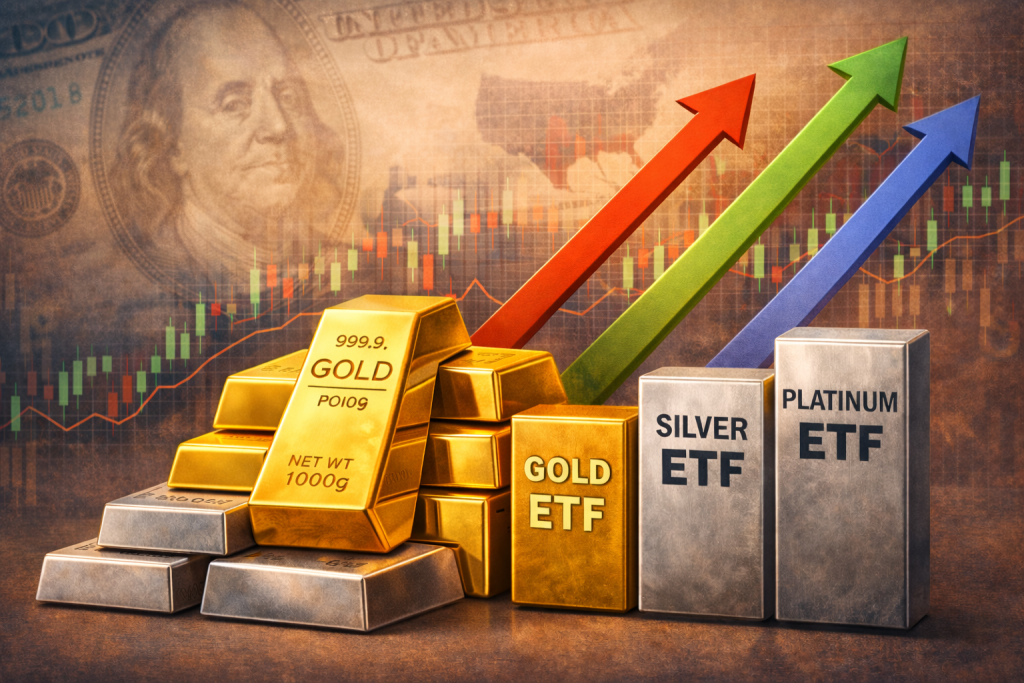
Precious Metals ETFs See Strong Inflows What Investors Are Positioning For
In recent years, exchange-traded funds (ETFs) have become one of the most important tools for understanding investor behavior. Unlike price movements, which can be influenced by short-term speculation or market noise, ETF flows often reveal how capital is being positioned with a longer-term perspective.
As global uncertainty remains elevated entering 2026, precious metals ETFs have seen a noticeable increase in inflows. Gold, silver, platinum, and palladium ETFs are attracting renewed interest from both institutional and retail investors. This trend is not happening in isolation. It reflects a broader reassessment of risk, return expectations, and portfolio construction in an increasingly complex global environment.
This article explores why precious metals ETFs are seeing strong inflows, what these flows signal about investor positioning, and how macroeconomic, geopolitical, and financial dynamics are shaping demand.
Why ETF Flows Matter More Than Prices
ETF flows provide insight into investor intent rather than short-term market reactions. When capital flows into an ETF, it reflects a decision to allocate exposure over time, not just to trade a price movement.
In the case of precious metals, ETF inflows suggest that investors are not simply reacting to headlines or chasing momentum. Instead, they are deliberately increasing exposure to assets perceived as resilient in uncertain conditions.
This distinction is important. While prices can rise and fall quickly, sustained ETF inflows indicate structural demand rather than speculative activity.
The Changing Global Investment Environment
The global investment environment entering 2026 is defined by several overlapping themes. Economic growth remains uneven across regions. Inflation has moderated from peak levels but continues to show structural persistence. Monetary policy is transitioning from restrictive to more accommodative stances. At the same time, geopolitical tensions and supply chain vulnerabilities remain unresolved.
Together, these factors create an environment where traditional risk-return assumptions are being challenged. Investors are increasingly focused on capital preservation, diversification, and resilience rather than pure growth.
Precious metals ETFs fit naturally into this framework.
Gold ETFs: The Anchor of Precious Metals Demand
Gold ETFs continue to account for the majority of precious metals ETF inflows. This dominance is not surprising. Gold remains the most liquid and widely recognized precious metal, with deep global markets and strong historical performance during periods of uncertainty.
ETF inflows into gold reflect several strategic considerations. Gold is seen as a hedge against geopolitical risk, inflation uncertainty, and currency volatility. It also benefits from expectations of monetary easing, which reduce the opportunity cost of holding non-yielding assets.
Importantly, gold ETF demand is not limited to one region. Inflows are coming from a broad range of markets, highlighting gold’s role as a global asset rather than a regional trade.
Silver ETFs and the Balance Between Risk and Growth
Silver ETFs have also attracted increased interest, though for different reasons than gold.
Silver occupies a unique position as both a precious and industrial metal. While it shares gold’s safe-haven characteristics, it is also closely tied to industrial demand, particularly in energy transition technologies and electronics.
ETF inflows into silver suggest that investors are positioning for a combination of risk protection and potential upside tied to long-term structural trends. This dual role makes silver more volatile than gold, but also more responsive to shifts in macro expectations.
As investors look to balance defensiveness with growth exposure, silver ETFs are gaining relevance.
Platinum and Palladium ETFs: A More Selective Interest
Platinum and palladium ETFs represent a smaller but increasingly important segment of precious metals demand.
These metals are more tightly linked to industrial applications, especially in the automotive sector. Their supply is geographically concentrated, making them sensitive to geopolitical developments and supply chain disruptions.
ETF inflows into platinum and palladium suggest that some investors are seeking diversification within the precious metals complex. Rather than focusing solely on gold, they are spreading exposure across metals with different demand drivers.
This trend reflects a more nuanced approach to precious metals allocation, where investors consider relative value, supply risk, and industrial dynamics.
Geopolitical Risk as a Driver of ETF Demand
Geopolitical tensions play a central role in shaping precious metals ETF inflows.
Ongoing conflicts, trade disputes, sanctions, and political uncertainty affect global confidence and increase risk premiums across markets. These conditions encourage investors to seek assets that are less exposed to political decision-making and sovereign risk.
Precious metals, particularly gold, are viewed as neutral assets that do not depend on the stability or credibility of any single government. ETFs provide a convenient and liquid way to access this exposure.
As geopolitical risk remains persistent rather than episodic, ETF demand reflects a longer-term adjustment rather than short-term fear.
Monetary Policy Expectations and Precious Metals ETFs
Expectations around monetary policy have a significant influence on precious metals ETF flows.
As central banks signal a gradual shift toward more accommodative policies, real yields are expected to remain under pressure. Lower real yields increase the relative attractiveness of precious metals, which do not generate income but offer value preservation.
ETF inflows often accelerate during periods when markets anticipate policy easing. Investors position ahead of rate changes rather than reacting after they occur.
This forward-looking behavior helps explain why precious metals ETFs continue to attract inflows even when price movements appear relatively stable.
Inflation Uncertainty and Capital Allocation
Inflation remains a key concern for investors, not because of its absolute level, but because of uncertainty around its trajectory.
Structural factors such as energy transition costs, geopolitical fragmentation, and supply chain realignment contribute to inflation volatility. Even when headline inflation declines, confidence in long-term price stability may remain weak.
Precious metals ETFs offer exposure to assets historically associated with inflation protection. As a result, they become an attractive tool for managing inflation risk within diversified portfolios.
Institutional Investors and ETF Adoption
Institutional investors play a significant role in driving ETF inflows.
Pension funds, asset managers, and sovereign wealth funds increasingly use ETFs to adjust asset allocation efficiently. Precious metals ETFs allow institutions to gain exposure without the logistical challenges of physical storage.
Institutional demand tends to be more stable and longer-term than retail flows. As more institutions formalize precious metals allocations, ETF inflows become less sensitive to short-term market volatility.
This institutional participation strengthens the structural demand underpinning precious metals ETFs.
Retail investors also contribute to ETF inflows, particularly during periods of heightened uncertainty.
ETFs lower the barriers to entry for precious metals investing. They provide transparency, liquidity, and ease of access, making them appealing to investors seeking diversification without complexity.
As financial education improves and awareness of portfolio risk increases, retail participation in precious metals ETFs continues to grow.
ETFs Versus Physical Precious Metals
One reason ETF demand has grown is the comparison with physical metal ownership.
While physical gold and silver offer direct ownership, they come with storage, insurance, and liquidity considerations. ETFs, by contrast, offer exposure without these operational challenges.
For many investors, ETFs represent a practical compromise between physical ownership and financial exposure.
This convenience helps explain why ETF inflows have become a key indicator of precious metals demand.
Portfolio Diversification and Correlation Dynamics
Precious metals ETFs play an important role in portfolio diversification.
Traditional diversification strategies have faced challenges as correlations between equities and bonds have increased during periods of stress. Precious metals, particularly gold, have historically shown lower correlation with financial assets during such periods.
ETF inflows suggest that investors are actively using precious metals to enhance portfolio resilience rather than as speculative trades.
Are Investors Preparing for a More Volatile Future?
The pattern of ETF inflows raises an important question: are investors positioning for prolonged volatility rather than a quick return to stability?
The evidence suggests that many investors expect uncertainty to remain elevated. Geopolitical tensions, policy transitions, and structural economic shifts point toward a more complex market environment.
Precious metals ETFs offer a way to prepare for this reality without making aggressive directional bets.
Understanding ETF Flows in Context
It is important to interpret ETF inflows within a broader context.
Inflows do not necessarily imply expectations of rapid price appreciation. Instead, they often reflect a desire for balance and protection.
Precious metals ETFs serve as tools for managing risk, not just for seeking returns. This perspective helps explain why inflows can remain strong even during periods of modest price movement.
What ETF Inflows Signal About Market Sentiment
ETF flows offer insight into collective market sentiment.
Strong inflows into precious metals ETFs suggest that investors are cautious, forward-looking, and focused on resilience. They indicate a preference for assets that perform across a range of scenarios rather than relying on a single macro outcome.
This sentiment aligns with a world where uncertainty is not a temporary disruption, but a defining feature.
The Role of Precious Metals ETFs in 2026
As 2026 unfolds, precious metals ETFs are likely to remain an important part of global portfolios.
Their appeal lies in their ability to combine accessibility, liquidity, and exposure to assets with long-standing value preservation characteristics.
Whether driven by geopolitical risk, monetary policy shifts, or inflation uncertainty, ETF demand reflects a rational response to a complex environment.
Conclusion
The strong inflows into precious metals ETFs are not a coincidence. They represent a deliberate shift in how investors are positioning capital amid global uncertainty.
Gold, silver, platinum, and palladium ETFs each attract interest for different reasons, but together they reflect a broader reassessment of risk and diversification.
Rather than signaling short-term speculation, ETF inflows point to strategic positioning focused on resilience and long-term stability. As global markets continue to navigate uncertainty, precious metals ETFs are likely to remain a key component of investor portfolios.