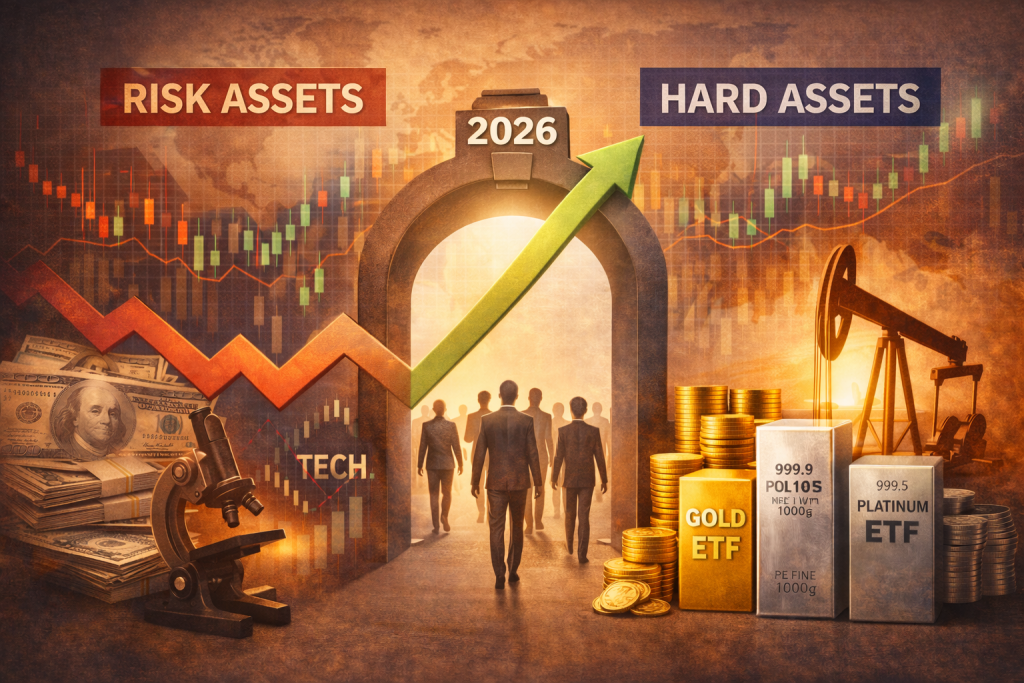
Are Investors Shifting From Risk Assets to Hard Assets in 2026?
Financial markets constantly evolve in response to economic cycles, policy shifts, and geopolitical developments. In 2026, one of the most noticeable themes emerging across global markets is a potential shift in investor behavior, a gradual reallocation from traditional risk assets toward hard assets.
Hard assets, including precious metals, commodities, and real assets with intrinsic value, are increasingly gaining attention as investors reassess risk exposure in an environment defined by uncertainty. While equities and growth-oriented investments remain central to portfolios, capital flows suggest that investors are seeking greater balance and resilience.
This shift is not necessarily about abandoning risk assets altogether. Instead, it reflects a more nuanced approach to portfolio construction, where investors incorporate assets that can provide protection during volatility, inflation pressure, or geopolitical disruption.
This article explores whether investors are truly moving from risk assets to hard assets in 2026, the forces driving this behavior, and what it may mean for markets going forward.
What Are Risk Assets and Hard Assets?
To understand the potential shift, it is important to define the two categories clearly.
Risk assets generally include equities, high-yield bonds, emerging market investments, and other instruments whose performance depends heavily on economic growth, liquidity conditions, and investor sentiment. These assets tend to perform well during periods of economic expansion and stable financial conditions.
Hard assets, on the other hand, are tangible or scarcity-based assets that derive value from physical properties or limited supply. Examples include gold, silver, industrial metals, commodities, and certain forms of real estate or infrastructure.
Hard assets often gain relevance when investors are concerned about inflation, currency depreciation, or systemic risk.
Why 2026 Feels Different From Previous Cycles
Market cycles are not new. Investors have always rotated between growth-oriented and defensive assets depending on economic conditions. However, the environment entering 2026 presents several unique characteristics that make the current shift more significant.
Global debt levels remain elevated, limiting policy flexibility. Inflation uncertainty persists even as headline numbers moderate. Geopolitical tensions continue to affect supply chains, trade flows, and energy markets. At the same time, monetary policy is transitioning after a period of aggressive tightening.
These overlapping dynamics create a landscape where traditional assumptions about risk and return are being reconsidered.
Monetary Policy Transition and Asset Allocation
Monetary policy is one of the most influential factors shaping investor behavior.
After years of tightening to combat inflation, central banks are increasingly expected to move toward more accommodative stances. While policy rates may remain above historical lows, the direction of change matters more than absolute levels.
Expectations of easing reduce real yields and increase liquidity in financial systems. This environment tends to support both risk assets and hard assets, but it also encourages diversification.
Investors anticipating policy shifts may increase exposure to hard assets as a hedge against policy uncertainty and inflation risk.
Inflation Concerns and the Search for Value Preservation
Inflation remains a central theme influencing capital allocation decisions.
Even though inflation has moderated compared to previous peaks, structural drivers remain present. Energy transition costs, geopolitical fragmentation, labor shortages, and supply chain realignment all contribute to long-term inflation uncertainty.
Hard assets historically perform well in environments where purchasing power concerns increase. Gold and commodities are often viewed as protection against currency erosion and price instability.
As investors reassess long-term inflation risks, hard assets naturally become more attractive within diversified portfolios.
Geopolitical Risk and Market Behavior
Geopolitical tensions play a critical role in shaping the shift toward hard assets.
Conflicts, sanctions, and political instability influence global trade and energy markets, creating uncertainty around economic growth and inflation trajectories. These conditions encourage investors to seek assets less dependent on political decisions or institutional stability.
Hard assets, particularly precious metals, are perceived as neutral stores of value. They are not liabilities of governments and do not depend on corporate earnings.
As geopolitical risk remains persistent rather than temporary, demand for hard assets becomes more structural.
Equity Market Valuations and Risk Perception
Equity markets have delivered strong returns in certain periods, but valuations remain an important consideration.
When valuations rise significantly, future return expectations may moderate. Investors seeking balance may increase allocations to assets with different risk characteristics.
This does not imply a bearish outlook for equities. Instead, it reflects portfolio optimization, where exposure to hard assets helps manage downside scenarios without abandoning growth opportunities.
Commodities and the Real Economy Connection
Commodities are closely tied to the real economy, making them sensitive to supply disruptions and structural demand trends.
Energy markets, industrial metals, and agricultural commodities are influenced by geopolitical developments, technological shifts, and demographic trends. These connections provide diversification benefits relative to financial assets.
As investors recognize the strategic importance of commodities, hard asset exposure becomes more appealing.
Precious Metals as Strategic Hard Assets
Among hard assets, precious metals occupy a special position.
Gold, in particular, has historically served as a hedge against systemic risk, currency depreciation, and financial instability. Silver adds exposure to industrial growth trends, while platinum and palladium provide diversification within the metals complex.
In 2026, precious metals are attracting attention not only for defensive reasons but also for their role in balanced portfolios.
Institutional Investors and Hard Asset Allocation
Institutional investors are increasingly incorporating hard assets into strategic allocations.
Pension funds, sovereign wealth funds, and asset managers seek diversification across economic scenarios. Hard assets provide exposure to inflation protection, geopolitical resilience, and supply-driven price dynamics.
Institutional participation tends to be longer-term and more stable, contributing to structural demand for hard assets.
Portfolio Diversification in a Changing Correlation Environment
Traditional diversification strategies have faced challenges in recent years.
Equities and bonds have not always provided offsetting performance during periods of stress. Correlations have increased, reducing the effectiveness of conventional asset allocation models.
Hard assets offer diversification benefits because their drivers differ from those of financial assets. This makes them valuable in portfolio construction.
Are Investors Abandoning Risk Assets?
Despite the growing interest in hard assets, investors are not necessarily abandoning risk assets altogether.
Equities remain essential for long-term growth, innovation exposure, and income generation. The shift toward hard assets is better understood as rebalancing rather than replacement.
Investors are seeking portfolios that perform across multiple scenarios rather than relying heavily on a single economic outcome.
Behavioral Factors and Market Psychology
Investor psychology plays a significant role in asset allocation shifts.
Periods of uncertainty encourage risk awareness and defensive positioning. Memories of past volatility influence decision-making, even when conditions stabilize.
Hard assets provide psychological comfort by offering perceived stability and tangible value.
Hard Assets in a Multipolar Economic World
The global economy is becoming more fragmented, with shifting alliances and economic competition.
This multipolar environment increases uncertainty around trade policy, currency stability, and geopolitical relationships. Hard assets, which are globally recognized and politically neutral, become more valuable in such contexts.
Long-Term Structural Trends Supporting Hard Assets
Several long-term trends support interest in hard assets.
Infrastructure investment, energy transition, resource scarcity, and demographic changes all influence demand for tangible assets. These trends extend beyond short-term economic cycles.
Investors incorporating hard assets into portfolios are often responding to these structural forces rather than temporary conditions.
What This Means for Markets in 2026
The potential shift toward hard assets does not signal a dramatic market transformation. Instead, it reflects gradual evolution in how investors manage risk.
Markets may continue to experience volatility as economic data, policy decisions, and geopolitical developments interact. Hard assets provide tools for navigating this complexity.
Conclusion
The growing interest in hard assets in 2026 reflects a broader reassessment of risk, diversification, and resilience.
Investors are not abandoning growth opportunities. Instead, they are seeking balance in an environment defined by uncertainty and structural change.
Hard assets offer characteristics that complement traditional financial investments, making them increasingly relevant within modern portfolios.
As global conditions continue to evolve, the relationship between risk assets and hard assets is likely to remain dynamic, shaping investment strategies for years to come.