Modular vs Monolithic Blockchains Explained
Last Updated: May 14, 2026
Methodology: This analysis is based on real-world 2026 network data, comparing the tech behind Layer 1 and Layer 2 ecosystems specifically looking at how all-in-one “monolithic” chains stack up against modular networks like Celestia.
What is Modular vs Monolithic Blockchain?
The blockchain industry is facing a major scalability challenge. For a long time, the go-to method was building networks that tried to do absolutely everything on one layer. Unsurprisingly, as more people jumped into crypto, these legacy systems started crawling under heavy loads.
To fix this, the Web3 space has split into two camps: Monolithic and Modular.
If you want to know whether a network can survive long-term, keep transaction fees low, and actually scale, you need to understand the difference between the two. Let’s lift the hood on both designs, break down the pros and cons, and look at how they’re playing out in the market right now.
What Is the Difference Between Modular and Monolithic Blockchains?
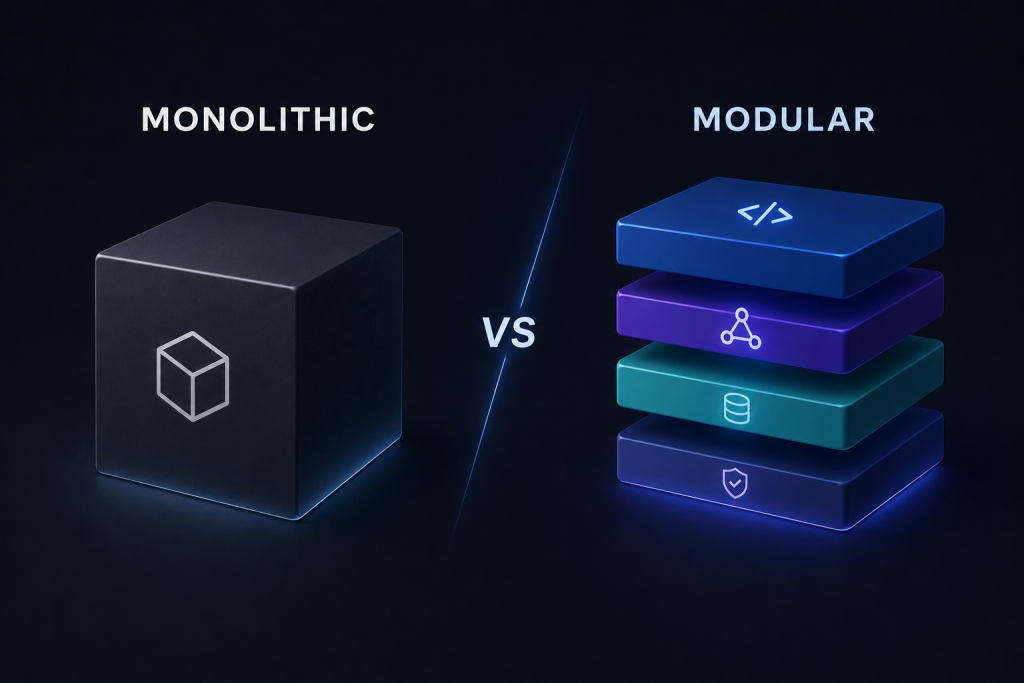
A monolithic blockchain handles all core functions execution, consensus, data accessibility, and settlement within a single layer. A modular blockchain, on the other hand, divides these functions into specialized layers, each optimized independently.
Quick Summary:
- Monolithic chains (e.g. Bitcoin, early Ethereum) do everything in one place — simple but limited in scalability
- Modular chains (e.g. Celestia, Ethereum post-Merge + rollups) split tasks across layers for greater throughput
- The architectural choice directly impacts transaction speed, cost, decentralization, and developer flexibility
Real-World Example:
Think of a monolithic chain like a single restaurant kitchen where one chef handles prep, cooking, plating, and billing. A modular chain is like a commercial kitchen with specialized stations — one team preps, one cooks, one handles logistics. Each station is faster and more optimized at its specific task.
How Does a Monolithic Blockchain Work?
In a monolithic architecture, every node on the network is responsible for:
- Executing transactions (processing smart contracts and state changes)
- Reaching consensus (agreeing on the valid state of the chain)
- Storing data (maintaining full history for verification)
- Settling disputes (acting as the final source of truth)
Because every node must do everything, scaling monolithic chains is inherently difficult. Increasing throughput typically requires increasing hardware requirements — which reduces the number of nodes that can participate and threatens decentralization.
Examples of Monolithic Blockchains:
- Bitcoin
- Solana
- BNB Chain
- Early Ethereum (pre-Merge)
Solana is a notable case: it achieves high throughput by demanding extremely powerful validator hardware, which critics argue compromises decentralization in exchange for speed.
How Does a Modular Blockchain Work?
Modular blockchains decompose the four core functions into independent layers, each handled by a purpose-built protocol.
| Layer | Function | Example Protocols |
| Execution | Process transactions, run smart contracts | Optimism, Arbitrum, StarkNet |
| Settlement | Finalize state, resolve disputes | Ethereum |
| Consensus | Order transactions and agree on validity | Celestia, Ethereum |
| Data Availability | Ensure transaction data is accessible | Celestia, EigenDA, Avail |
Rather than one chain doing all four, modular stacks allow developers to mix and match layers. An Ethereum rollup, for example, executes transactions off-chain, posts data to a data availability layer, and settles on Ethereum mainnet.
Monolithic vs Modular Blockchain: Key Differences
| Feature | Monolithic Architecture | Modular Architecture |
| Architecture | Single integrated layer | Multiple specialized layers |
| Scalability | Limited (bottlenecked by all-in-one design) | High (each layer scales independently) |
| Decentralization | Trade-off required for speed | Preserved through layer separation |
| Developer Flexibility | Constrained by base layer rules | High — mix-and-match layers |
| Complexity | Low | Higher (more moving parts) |
| Security Model | Unified | Inherited or shared across layers |
| Examples | Bitcoin, Solana, BNB Chain | Ethereum + rollups, Celestia-based chains |
What Are the Advantages of Modular Blockchains?
1. Independent Scalability Each layer can be scaled without affecting the others. A data availability layer can increase throughput without modifying the execution environment.
2. Specialization Efficiency Protocols optimized for one task outperform general-purpose systems. Celestia, for example, focuses entirely on data availability and achieves higher data throughput than chains that treat it as a secondary concern.
3. Sovereignty Without Sacrificing Security Application-specific chains (appchains) built on modular stacks can have their own governance and execution rules while inheriting security from established settlement layers like Ethereum.
4. Lower Costs for End Users By offloading execution to rollups and data availability to cheaper specialized layers, transaction fees for users can drop significantly. Post-EIP-4844, Ethereum blob transactions reduced L2 data costs by over 90% in several rollup ecosystems.
What Are the Advantages of Monolithic Blockchains?
1. Simplicity There is one codebase, one security model, and one community to maintain. This reduces coordination risk and attack surface across multiple interdependent systems.
2. Atomic Composability All applications share the same state. DeFi protocols can interact with each other in a single transaction without bridging, latency, or cross-layer communication complexity.
3. Proven Security Bitcoin and Ethereum’s base layer security models have been stress-tested over more than a decade. Monolithic chains with large validator sets benefit from well-understood threat models.
4. Easier Onboarding For developers building on established chains like Solana or BNB Chain, there is no need to reason about multiple layers, bridges, or sequencer dependencies.
What Are the Risks of Modular Blockchains?
- Fragmented Liquidity: Assets and users spread across multiple execution layers create liquidity silos, making DeFi less efficient
- Bridge Risk: Cross-layer communication introduces smart contract and trust assumptions that have historically been exploit vectors
- Complexity Overhead: Developers must reason about multiple layers, sequencer behavior, and data availability guarantees simultaneously
- Nascent Ecosystem: Many modular components (e.g. EigenDA, Avail) are still maturing, with limited track records compared to monolithic alternatives
Where Is the Industry Heading in 2026?
The industry trend has clearly shifted toward modular design. Ethereum’s roadmap centered on rollups, danksharding, and EIP-4844 — is explicitly modular. As of 2026, over 70 rollups are live on Ethereum according to L2Beat, collectively processing more daily transactions than any single monolithic chain.
Celestia’s launch and rapid adoption validated the thesis that data availability can be a standalone service. Projects like Eclipse (Solana VM on Celestia DA) and Dymension (rollup settlement hub) demonstrate that modular components are being actively composed by developers.
That said, monolithic chains are not obsolete. Solana continues to attract developers who prioritize composability and low-latency execution in a single environment, particularly for high-frequency DeFi and consumer applications.
The trajectory: Modular wins for scalability and flexibility. Monolithic wins for composability and simplicity. The optimal choice depends on the application.
Which Is Right for Your Use Case?
| Use Case | Recommended Architecture |
| High-frequency DeFi with atomic composability | Monolithic (e.g. Solana) |
| High-throughput consumer apps needing low fees | Modular (e.g. Ethereum L2s) |
| Application-specific chain with custom logic | Modular (appchain via Cosmos/Celestia) |
| Store-of-value or maximum security | Monolithic (Bitcoin) |
| Cross-chain or multi-environment dApp | Modular stack with IBC or bridging layer |
Start Trading on a Scalable Infrastructure
Understanding blockchain architecture helps you evaluate which networks are built to scale and which assets are positioned to benefit.
Trade crypto assets across leading blockchain ecosystems with advanced tools and 24/7 liquidity on ICRYPEX.